Commercial Roofing in Van Nuys for Corridor Buildings
Commercial roofing Van Nuys work is flat and low-slope work: membranes, drainage, parapets, curbs, and phased schedules that keep a building open. BFiber Roofing Repair & Install, based at 14202 Hamlin St, serves the corridor and industrial stock along Van Nuys Boulevard, Sherman Way, Victory Boulevard, and the airport fringe, where the roof is a building system rather than a house detail.
We photograph itNails and debris swept from the yard
We tarp itPermit and inspection steps explained
We clean upScope described in plain terms
What our Commercial Roofing service includes
A commercial scope is priced by roof area and system, not by house size. Here is what it covers, from inspection to handoff records.
Full roof inspection
The full roof is inspected and scanned for moisture, with drains, seams, curbs, and parapets documented, so the scope covers the damage that is actually there.
Tear-off and disposal
Old membrane and wet insulation come off in phases, debris is hauled away, and the building stays dried in between phases so operations are not interrupted overnight.
New membrane installation
A new membrane goes on — TPO, EPDM, or modified bitumen, chosen for the building's slope, traffic, and drainage — with tapered insulation where the roof needs slope it does not have.
Flashing and edge metal
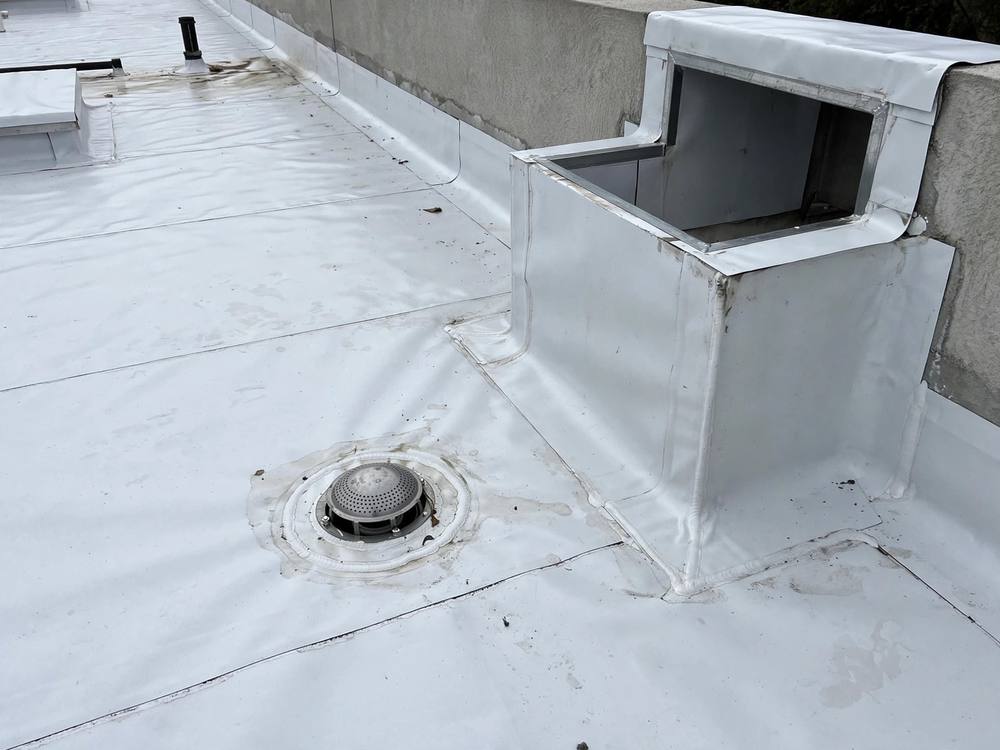
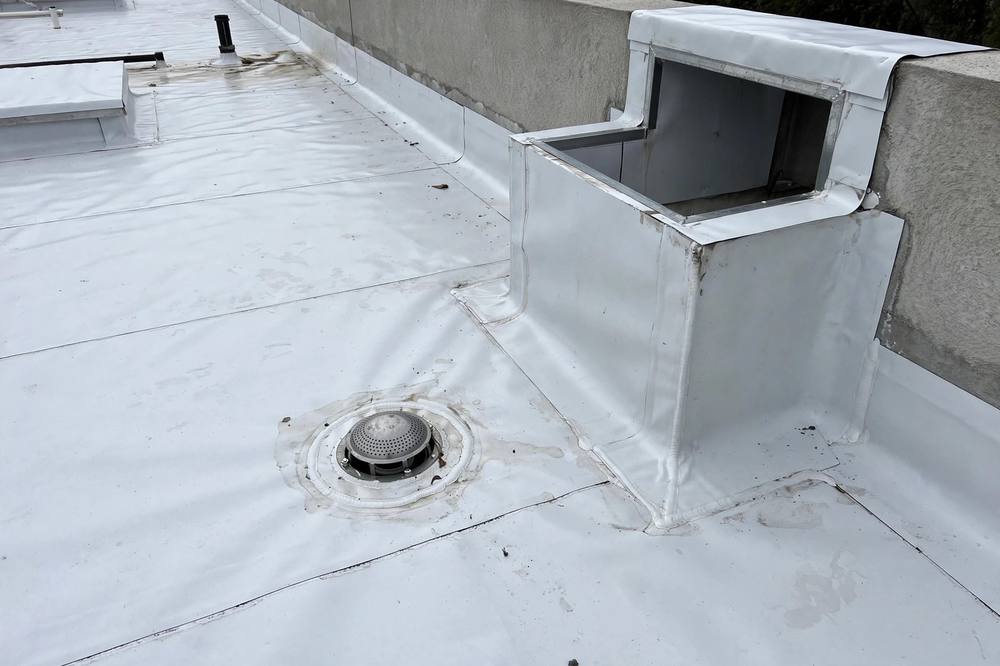
Flashing and edge metal are rebuilt at parapets, curbs, vents, and skylights, the details where commercial leaks begin, and edge metal is fastened for the wind exposure the building actually sees.
Drainage and gutter work
Drainage and gutter work are part of the scope: drains reset, scuppers cleared and sized, and gutters tied into the system so water leaves the roof instead of sitting on seams.
Final documentation
You receive final documentation: photos, a written scope record, a moisture map where scanning was done, and a maintenance log for the next crew.
Homes and businesses.
The approach is the same for a home and a business: inspect first, scope in writing, then build. What changes is access, scheduling, and who needs the paperwork.
For homes
For a home, commercial roofing rarely applies directly, but the same flat systems appear on garages, additions, and small apartment buildings, where the work follows the house's schedule.
Garage roof ponding
Tile underlayment wear
Skylight flashing leak
For businesses
For a business, commercial roofing means a retail, warehouse, multifamily, or office building whose roof must be replaced or repaired without closing the operation below it.
Warehouse TPO replacement
Retail edge metal repair
Apartment flashing rebuild
What Commercial Roofing in Van Nuys actually covers
A plain-language look at what commercial roofing actually covers in Van Nuys, and why it is scoped differently from house roofing.
Commercial roofing in Van Nuys covers the corridor and industrial stock: shops and offices along Van Nuys Boulevard, Sherman Way, and Victory Boulevard, apartment buildings whose flat roofs serve many units, and warehouses and hangar-adjacent buildings near Van Nuys Airport. Those roofs are flat or low-slope, carry HVAC curbs, parapets, drains, and penetrations, and are usually decided by an owner or manager rather than an occupant, which changes how the scope is written and phased.
The commercial market here is inseparable from the apartment boom of the 1960s and 1970s and the commercial corridors that grew with it. Flat and low-slope membranes — TPO, modified bitumen, and built-up systems — dominate that stock in Los Angeles apartment and commercial guides, and the work pattern is leak response, drainage and seam maintenance, and phased re-cover rather than single-house re-roofs.
A commercial roof is a building system: membrane, insulation, drainage, and flashing have to work together, and the schedule has to work around the business below.
What it is
Design, installation and repair of low-slope membrane roofs on commercial buildings.
What to expect
Inspection with photos, written scope, phased installation and a final walk-through.
How a commercial roofing project runs
A predictable sequence, so you know what happens on each visit and what is being decided before it is built.
Roof inspection
The roof is inspected and scanned for moisture, with drains, seams, curbs, and parapets documented, so the scope is written from evidence rather than from a leak report alone.
Walk roof
Scan moisture
Photo report
Scope and materials
The system is chosen — TPO, EPDM, or modified bitumen — with insulation, drainage correction, and Title 24 cool-roof requirements noted, since nonresidential low-slope re-roofs in the sourced figures call for aged reflectance 0.63, emittance 0.75, and SRI 75.
Pick system
Order materials
Confirm scope
Tear-off and prep
Old membrane and wet insulation come off in phases, the deck is prepared, and the building stays dried in between phases.
Tear off
Protect building
Replace decking
Installation
The new membrane is installed with flashing and edge metal rebuilt at every curb, vent, and parapet, and drains are reset as the work advances.
Install membrane
Detail flashing
Test drains
Final walk and handoff
The finished roof is walked with you, drains are tested, and photos, scope records, and a maintenance log are handed off for the building's files.
Final walk
Hand off records
Set schedule
Tools and methods we use
The tools matter less than the sequence they serve. Here is what each one does on a Van Nuys commercial roof, and the methods that tie them together.
Infrared camera
Reveals temperature differences that point to trapped moisture inside the roof assembly, narrowing the search before anything is opened.
Moisture meter
Confirms whether decking or insulation is actively wet or old, so the scope replaces what is actually damaged rather than what merely looks stained.
Roofing nail gun and air compressor
Drives fasteners at the correct depth and pattern when membrane and edge details are set, so the new system holds through Santa Ana gusts that in strong Valley events run 50–65 mph.
Pry bar and utility knife
Opens suspect membrane and flashing details for a closer look, and cuts membrane cleanly, without tearing up the surrounding field.
Chalk line and shingle cutter
Lays out straight courses and trims membrane and underlayment to fit, because a crooked seam becomes a water path in the first concentrated winter rain.
The thermal illustrations on this page are generated from photographs and are not measurements of your roof.
Methods
Roofing ladder and safety harness
Gets the crew on and off the roof safely on multi-story buildings without disrupting tenants or operations below.
Leaf blower
Clears debris from the roof field, valleys, and gutters so the actual surface can be seen, rather than inspected through a layer of leaves.
Infrared moisture survey
An infrared survey maps wet insulation across the field, so the scope replaces what is wet and keeps what is dry, instead of guessing at the boundary.
Title 24 cool-roof compliance
For nonresidential low-slope re-roofs, the sourced Title 24 figures are aged reflectance 0.63, thermal emittance 0.75, and SRI 75, with the parcel's climate zone confirmed on the permit; no nonresidential steep-slope re-roof figure is published here.
Flashing Details
Flashing is built to standard practice at curbs, vents, skylights, and parapets, since flashing failure, not field wear, is where most commercial leaks begin.
Water testing
Water is run over drains and repaired details before the crew leaves, so drainage is demonstrated rather than assumed.
When to call for commercial roofing
Tenant leak
A tenant reports a ceiling stain after the first big rain of the season.
The roof is inspected, moisture is scanned, and the entry point is traced — often a flashing or curb detail — then repaired with the surrounding field checked for the same failure.
Outcome:The leak stops, the tenant stays put, and the repair is documented with photos for the building's records.
Aging TPO
An ageing TPO roof is inspected, wet insulation is measured, and the options for full replacement versus recover are compared from the scan, so the decision is made from the roof's actual condition rather than from its age alone.
Wind damage
A windstorm peels edge metal off a retail building and water enters a stockroom.
The damaged area is dried in, everything is photographed for the record, and edge metal is rebuilt with fastening suited to the building's wind exposure.
Outcome:Inventory is protected, the damage is documented, and the roof is back to full strength with edge details that were the storm's first failure point.
Building purchase
You are buying a Van Nuys commercial building and need to know what the roof will cost you.
A full inspection with moisture mapping, photos, and a written report covers remaining life, leak sources, and flashing and underlayment condition, so the purchase price reflects the roof honestly.
Outcome:You negotiate from documented findings instead of a guess, and you know what the roof will need in its first years.
Maintenance plan
A property manager wants a maintenance program instead of reactive repairs.
A seasonal program is set up: drain and gutter clearing, seam, flashing, and fastener checks, with findings photographed and recorded for capital planning.
Outcome:Small issues get fixed before they become leaks, and the roof's condition is tracked year over year instead of discovered by the next storm.
Van Nuys Airport AreaVan Nuys Civic CenterVan Nuys
How Commercial Roofing works in Van Nuys
Van Nuys commercial roofing follows the corridors. Van Nuys Boulevard has been the Valley's commercial spine since the streetcar era, Sherman Way and Victory Boulevard carry the apartment and retail mix, and the airport fringe carries warehouses and industrial buildings with large low-slope roofs. Each corridor has its own flat-roof pattern: storefront parapets and signage penetrations on the boulevards, shared drains on apartment buildings, and HVAC curbs on warehouses.
Winter rain is concentrated, not spread out: the Van Nuys Airport normal is 13.42 inches a year, February alone averages 3.79 inches, and a single February day in 2024 delivered 4.30 inches. A commercial roof is therefore judged by its drainage first — drains, scuppers, and slope — because a flat roof that cannot shed a storm like that will leak no matter how sound its membrane looks.
Van Nuys is a neighborhood in the City of Los Angeles, annexed 22 May 1915, so permits run through LADBS, not the County. A full replacement requires an LADBS permit; a permit is required — confirm the repair-vs-re-roof line with LADBS for your scope.
Van Nuys Airport Area: Large warehouse and industrial roofs with heavy HVAC curb penetrations, where wind uplift at the roof edge gets extra attention in edge metal and fastening patterns.
Van Nuys Civic Center: Older masonry commercial buildings with flat roofs and limited drainage, where undersized scuppers back water up during winter storms.
Van Nuys: A mix of apartment buildings and small retail with flat and low-slope roofs, where tenant-occupied buildings need phased work and daily cleanup so parking and access stay usable.
Panorama City: Retail strips and auto-related businesses where roof leaks threaten inventory and equipment, so drying-in and documentation come first, then permanent repair.
Valley Glen: Commercial and light industrial parcels with a wide range of roof ages, where inspections usually turn up a mix of repairable details and insulation that has already been wet for years.
Summer heat: Valley afternoons average 91.2°F in July and 93.1°F in August at Van Nuys Airport, and dark membranes expand and contract with that heat, opening seams and pulling flashing from curbs; reflective membranes reduce that swing.
IllustrativeThe thermal view is generated from the photograph. It is not a measurement. Drag the handle, or use the arrow keys once it is focused.
Warehouse ponding water eliminated
Before:A warehouse near Van Nuys Airport had standing water near two drains and seams that failed every winter.
After:Tapered insulation corrected the slope and a new white membrane went on, with drain bowls reset so water reaches the drains instead of sitting on seams.
Apartment flashing leak fixed
Before:A 16-unit building leaked into two units every winter, and previous repairs had not held.
After:The failed flashing detail was opened, the metal and sealant were replaced, and the flashing was rebuilt with the surrounding field checked for the same failure.
A fall flashing and sealant check before the rain, plus spring gutter clearing, keeps the building ahead of the next winter.
Retail edge metal storm repair
Before:A windstorm tore edge metal off a retail building and water entered a stockroom.
After:The damaged area was dried in, everything was photographed for the record, and edge metal was rebuilt with fastening suited to the building's wind exposure.
Annual edge-metal and fastener checks before wind season, plus prompt drying-in after any storm damage, keep a retail roof from becoming an inventory problem.
Commercial roof problems we fix in Van Nuys
Commercial roofs in Van Nuys fail for a handful of reasons. Here is what is found, and how the work addresses each one.
Ponding waterPonding water sitting on the membrane after rainPonding water sitting on the membrane after rain finds seams and adds weight to the structure. The scope corrects slope with tapered insulation and reworks drains and scuppers so water leaves the roof.
Flashing failureFlashing failure at curbs, vents and skylightsFlashing at curbs, vents, and skylights fails as sealant dries out under Valley heat and metal moves with temperature. The work rebuilds the flashing detail with new metal tied into the field, rather than resealing over old work.
Blistering membraneBlistering membrane and granule lossBlistering membrane and granule loss signal trapped moisture and heat ageing. The scope scans for wet insulation, replaces what is wet, and rebuilds the field so the blister cycle does not restart.
Clogged guttersClogged gutters and scuppers backing water under the edgeClogged gutters and scuppers back water under the roof edge, rotting fascia and lifting membrane terminations. The scope clears drainage and checks the roof edge as one system.
Why building owners call us first
Commercial roofing is worth doing when it protects the building and the business below it. Here is what properly scoped work gives an owner or manager.
Leaks stopped at the source
A leak is traced to its source — flashing, curb, drain, or seam — instead of sealing the stain, so the same leak does not return with the next storm.
A Roof That Ages More Slowly
A roof whose drainage is corrected, whose seams are sound, and whose flashing is rebuilt ages more slowly than one left to the rain calendar, because each visit removes the small failures that compound into large ones.
A Cooler Roof Surface
A reflective membrane surface helps with summer heat on sun-exposed flat roofs, and on larger re-roofs the Title 24 cool-roof figures for nonresidential low-slope work are part of the scope, with the parcel's zone confirmed on the permit.
Tenants stay open
Phased work and daily cleanup keep tenants open and access usable, so the roof project does not become a business interruption.
What you receive
Clear records you can keep and share.
Photo report
The field, flashing, drains, and curbs photographed as found, before any work is discussed.
Written scope
Materials, steps, and scope in writing, discussed before work begins.
Moisture map
Wet insulation mapped across the field, so the scope replaces what is wet and keeps what is dry.
Maintenance log
A running log of visits, findings, and actions, so the building's roof history is in one place.
Single-ply versus modified bitumen roofs
Commercial flat roofs come down to system choice. Here is how the common single-ply and multi-ply options compare.
TPO membrane
A white single-ply membrane, heat-welded at the seams, and reflective against Valley heat.
Reflective surface helps with summer heat on sun-exposed roofs
Heat-welded seams, probed and tested as the work advances
Common fit for warehouses, retail, and apartment flat roofs
EPDM rubber
A dark rubber membrane, flexible and long-lived, with seams that need careful detailing.
Flexible in cold weather and forgiving on large, simple fields
Seams need careful splicing and regular checking
Dark surface absorbs more heat than a white membrane
Modified bitumen
A multi-ply asphalt system, familiar on older commercial roofs, with a granulated cap.
Multi-ply build, familiar to crews and owners alike
Granulated cap stands up to foot traffic
Heavier system, with insulation and slope built into the scope
Materials and systems we work with
TPO membrane
EPDM rubber
Modified bitumen
Standing seam metal
Roof underlayment
Flashing
Drip edge
Ridge vent
Towns we serve.
Based in Van Nuys and covering the places around it. Pick one for local details.
Call (818) 474-8963 to talk through your roof and its options.
Call (818) 474-8963 to discuss your roof and next steps.
Commercial roofing questions we hear every week
Published market data, not a quote from BFiber: a California guide puts commercial replacement from around $6 per square foot for a ballasted TPO overlay with no added insulation to around $25 per square foot for a 3-ply modified-bitumen system with enough insulation to meet the energy-code requirement for most of California, while Los Angeles flat-roof guides put most commercial flat replacements from $7–$14 per square foot. Your scope depends on area, system, insulation, tear-off, and deck condition, so call (818) 474-8963 to discuss your building.
BFiber Roofing Repair & Install, based at 14202 Hamlin St, Van Nuys, CA 91401. Call (818) 474-8963 to discuss your building and the areas served, including Van Nuys, Lake Balboa, Sherman Oaks, Panorama City, North Hills, and Valley Glen.
For most flat roofs here, a white single-ply membrane is the common fit in Los Angeles guides, balancing cost, reflectivity, and service life, while EPDM suits warehouses with little foot traffic and modified bitumen suits buildings with a multi-ply history. The right system depends on slope, drainage, traffic, and insulation needs, so the choice follows inspection rather than preceding it.
Maintenance visits are part of commercial roofing care: drain and gutter clearing, seam, flashing, and fastener checks, with findings photographed and recorded for capital planning. Visit timing follows the building's needs and the rain season; call (818) 474-8963 to discuss a program for your building.
Call (818) 474-8963 to discuss your roof and schedule a walk-through at a time that works for you. You get photos and a written scope to consider before you decide anything.