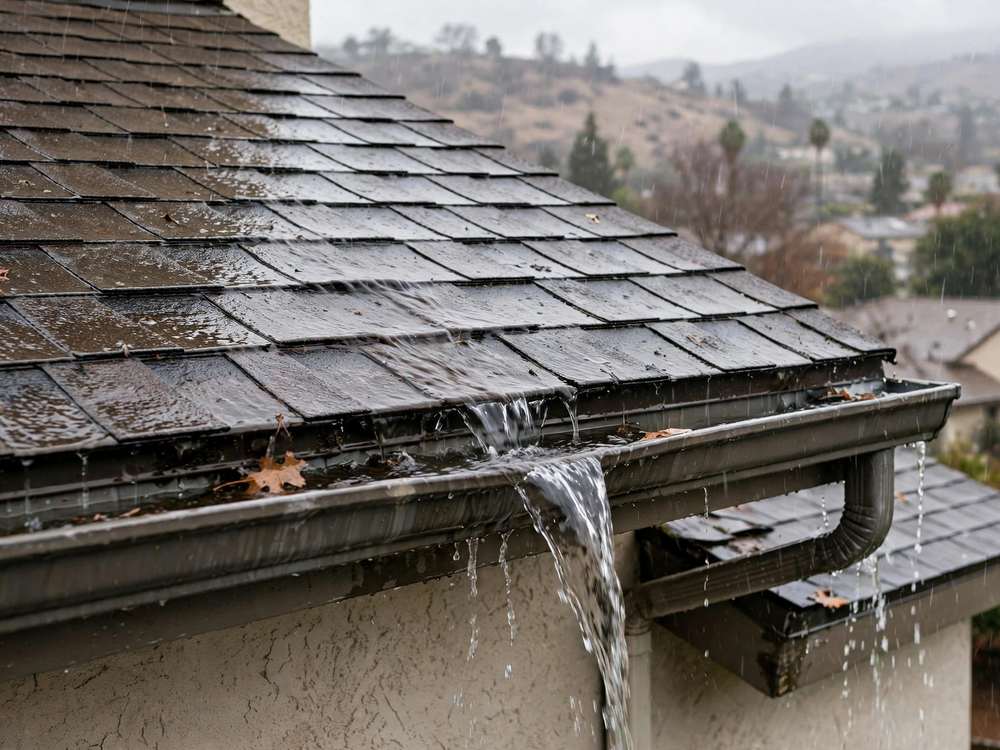
Roof Leak Repair in Van Nuys That Finds the Source
Roof leak repair Van Nuys work starts from one fact: the stain on the ceiling is rarely below the entry point. Water travels along decking, rafters, and underlayment before it shows inside, so BFiber Roofing Repair & Install, based at 14202 Hamlin St, traces each leak to its source — flashing, valley, penetration, or drain — before any repair is scoped.
Trace the sourceWater-test repairsPhoto documentation
We inspect firstDeck and flashing shown before closing
We test itNails and debris swept from the yard
We show youPermit and inspection steps explained
We clean upScope described in plain terms
What our roof leak repair includes
A leak repair scope is a tracing scope first and a patch scope second. Here is what it covers, from the first call to the follow-up record.
Full leak inspection
Leak tracing and photos: the field, flashing, valleys, and penetrations are inspected together, with the attic checked for the staining that shows where water actually travelled, since the entry point is usually upslope and sideways from where the ceiling shows it.
Source confirmation
Flashing and penetration repair at the failed detail — chimney, vent, skylight, or pipe boot — with the flashing rebuilt rather than resealed over old work.
Materials matched to your roof
Valley and edge repair where the valley or roof edge has failed, with the valley metal and underlayment rebuilt so the two slopes act as one roof.
Water test before we leave
A drainage check that clears gutters, downspouts, and drains, since a backed-up drain sends water under the roof edge and mimics a field leak.
Photo documentation
Follow-up documentation: photos of the source, the repair, and the surrounding field, recorded for the next person on the roof.
Homes and businesses.
The approach is the same for a home and a business: inspect first, scope in writing, then build. What changes is access, scheduling, and who needs the paperwork.
For homeowners
For a home, leak repair usually means a ceiling stain, a skylight drip, or a valley leak, where the source is traced in the field and the attic together before any repair is scoped.
Ceiling stain after rain
Skylight drip
Commercial TPO leak
For property managers
For a business, leak repair usually means a tenant-space drip or a warehouse leak, where drying-in and documentation come first, then the permanent repair.
Valley leak
Tenant leak complaints
Storm damage
What roof leak repair in Van Nuys, California involves
A plain-language look at what leak repair actually involves in Van Nuys, and why tracing matters more than sealing.
Leak repair in Van Nuys covers the whole stock: tract houses with shingle fields, Spanish houses with tile fields, apartment buildings with flat roofs, and commercial buildings with membrane fields. The leak sources are the same across that stock — flashing at chimneys, vents, skylights, and pipe boots; valleys where two slopes meet; penetrations where the field was cut; and drains that back water under the roof edge — and the repair is only as good as the tracing that found the source.
The Van Nuys rain calendar makes tracing harder, because the 13.42-inch annual normal arrives concentrated — February averages 3.79 inches, July 0.00 — so a roof sits dry for months, then must move several inches of water in a single storm, and a leak that appears in February may have entered at a detail that failed the previous summer. A single February day in 2024 delivered 4.30 inches, and that kind of storm finds every failed flashing and clogged drain in a single night.
A leak repair is a tracing job with a patch at the end, not a patch with tracing as an afterthought.
What it is
Finding where water enters your roof, fixing that point, and confirming the repair holds.
When you need it
When you see ceiling stains, dripping, or damp attic insulation after rain.
What to expect
An inspection, source confirmation, the repair, and a water test before we leave.
How our roof leak repair process works
A predictable sequence, so you know what happens on each visit and what is being decided before it is built.
Call and schedule
The call is triaged: where the stain shows, when it appears, and whether water is actively entering, so the first visit is aimed at the right part of the roof.
Call
Describe
Schedule
On-roof inspection
The roof and attic are inspected together, the water path is followed from the stain back to the entry point, and the source is photographed before any repair is discussed.
Inspect
Meter
Camera
Source confirmation
The damaged area is dried in where water is actively entering, so the interior is protected while the permanent repair is scoped.
Confirm
Hose test
Explain
Repair and seal
The permanent repair is built at the source — flashing rebuilt, valley rebuilt, penetration re-flashed, or drain cleared — with the surrounding field checked for the same failure.
Repair
Seal
Match materials
Test and walkthrough
The repair is photographed, the source and the surrounding field are recorded, and the follow-up is noted for the next rain season.
Test
Photos
Walkthrough
Tools and methods we use
The tools matter less than the sequence they serve. Here is what each one does on a Van Nuys leak repair, and the methods that tie them together.
Moisture meter
Confirms whether decking or underlayment is actively wet or old, so the scope repairs what is actually damaged rather than what merely looks stained.
Infrared camera
Reveals temperature differences that point to trapped moisture inside the roof assembly, narrowing the search before anything is opened.
Roofing nail gun and air compressor
Opens suspect shingles, tile, and flashing details for a closer look, and sets the field back after the source is found.
Pry bar and shingle cutter
Lays out straight courses and marks the water path, so the repair is aimed at the entry point rather than at the stain.
Chalk line and utility knife
Gets the crew on and off the roof safely, and keeps the work platform stable on steep tract roofs.
The thermal illustrations on this page are generated from photographs and are not measurements of your roof.
Methods
Roofing ladder and safety harness
Water is run over suspect details in sequence, so the entry point is demonstrated rather than guessed at.
Leaf blower
Flashing is rebuilt at the failed detail, since flashing failure, not field wear, is where most leaks begin.
Hose testing
Sealant and fasteners are checked across the field, since a backed-out fastener or dried sealant joint is a leak waiting for the next storm.
Flashing replacement
The valley is rebuilt with new metal and underlayment where the valley has failed, so the two slopes act as one roof.
Membrane patching
Drains and gutters are cleared and checked, since a backed-up drain sends water under the roof edge and mimics a field leak.
Attic ventilation check
The source, the repair, and the surrounding field are photographed, so the next person on the roof knows what was found and what was done.
When Van Nuys customers call us
Ceiling stain
A ceiling stain spreads every time it rains, and two previous repairs have not held.
The field and attic are inspected together, the stain's water path is followed back to a chimney flashing detail, and the flashing is rebuilt with new metal tied into the field rather than resealed over old work.
Outcome:The stain stops growing, and the repair record shows which flashing was rebuilt and which surrounding details were checked.
Commercial TPO
A property manager has water dripping into a tenant space from a flat TPO roof.
The seams and curbs are checked together, the leak is traced to a failed seam, and a heat-welded TPO patch is installed with drains cleared at the same time.
Outcome:The tenant space stays dry, and the repair record shows which seam was patched and which drains were cleared.
Emergency call
An active leak is called in during a storm, and water is entering the building.
The damaged area is dried in, the interior is protected, and the source is documented, so the permanent repair can be scoped from inspection once the storm passes.
Outcome:The interior is protected through the storm, and the permanent repair follows from the documented source rather than from a guess.
Skylight drip
A skylight drips every winter, and caulk repairs have not held.
The skylight curb flashing is removed and rebuilt with membrane tied into the surrounding field, because a skylight leak is almost always a flashing failure, not a glass failure.
Outcome:The skylight stays dry through its first winter, and the curb detail is photographed for the record.
Valley leak
A valley leaks every winter, and the stain appears well away from the valley itself.
The valley is opened, the valley metal and underlayment are rebuilt, and the two slopes are tied together so the valley acts as one roof.
Outcome:The valley stays dry, and the repair record shows which metal and underlayment were replaced.
Van NuysVan Nuys Civic CenterLake Balboa
How roof leak repair runs in Van Nuys
Van Nuys leak repair follows the tract stock and the rain calendar together. The postwar houses that fill the flat streets show the same leak sources — chimney flashing, pipe boots, valleys, and skylight curbs — and the concentrated winter rain means a leak that appears in February may have entered at a detail that failed the previous summer. A leak repair here is therefore judged by its tracing, not by its patch.
Van Nuys is a neighborhood in the City of Los Angeles, annexed 22 May 1915, so permits run through LADBS, not the County. A permit is required — confirm the repair-vs-re-roof line with LADBS for your scope.
Van Nuys: The tract stock that defines the neighborhood, where composition shingle roofs show the same leak sources — chimney flashing, pipe boots, valleys, and skylight curbs — again and again.
Van Nuys Civic Center: Older masonry buildings with mixed roof types, where a leak source is often a flashing or drain detail rather than the field itself.
Lake Balboa: Houses near the lake and park where skylight and pipe boot leaks are common, and where the leak source is usually a curb or boot detail rather than the field.
Sherman Oaks: Houses and small commercial buildings on the southern edge of the service area, where valley and flashing leaks follow the same pattern as the Van Nuys tract stock.
Panorama City: Postwar houses with shallow-pitched roofs, where valley and edge leaks are common and where a tune-up often prevents the next leak.
Summer heat: Valley afternoons average 91.2°F in July and 93.1°F in August at Van Nuys Airport, drying sealant and cracking pipe boots over the years; a leak that appears in February may have entered at a detail that failed the previous summer.
IllustrativeThe thermal view is generated from the photograph. It is not a measurement. Drag the handle, or use the arrow keys once it is focused.
Chimney flashing leak in Van Nuys
Before:A chimney flashing leak in Van Nuys spread a ceiling stain every time it rained, and two previous repairs had not held.
After:The old flashing was removed and new flashing was installed, tied into the field, with the surrounding details checked for the same failure.
Check chimney flashing every fall before the rain, and if you see rust or separation, have it inspected before the next storm.
TPO seam failure on a Civic Center commercial roof
Before:A TPO seam failure on a Civic Center commercial roof dripped water into a tenant space.
After:The seams were repaired with heat-welded TPO patches, drains were cleared, and the surrounding field was checked for the same failure.
Schedule a flat roof inspection every spring and fall, and clear drains before winter, so a seam failure is found before it becomes a tenant problem.
Cracked pipe boot in Lake Balboa
Before:A cracked pipe boot in Lake Balboa let water run down a plumbing vent pipe during rain.
After:The cracked boot was replaced with a new one sized to the pipe, and the surrounding field was checked for the same failure.
Look at your pipe boots every year, and if the rubber looks cracked or brittle, replace them before the next rain season.
Roof leak problems we fix in Van Nuys
Leaks in Van Nuys come from the same handful of failures. Here is what is found, and how the work addresses each one.
Flashing failureFlashing failure at chimneys, vents, and skylightsFlashing at chimneys, vents, and skylights fails as sealant dries out under Valley heat and metal moves with temperature. The work rebuilds the flashing detail with new metal tied into the field, rather than resealing over old work.
Pipe boot cracksValley failure where two slopes meetValley failure where two slopes meet opens a direct water path, and a valley leak often shows far from the valley itself. The repair rebuilds the valley metal and underlayment so the two slopes act as one roof.
Ponding waterPenetration leaks at pipe boots and ventsPenetration leaks at pipe boots and vents follow when the rubber boot cracks under Valley heat or the vent flashing separates. The repair replaces the boot or rebuilds the flashing, sized to the penetration.
Clogged guttersClogged drainage backing water under the roof edgeClogged drainage backing water under the roof edge lifts the field and rots fascia, mimicking a field leak. The scope clears drainage and checks the roof edge as one system.
Attic condensationAttic condensation mistaken for a roof leakAttic condensation mistaken for a roof leak appears as staining without a field failure, when ventilation is unbalanced and warm, moist air sits under a hot roof. The scope balances ventilation and checks the attic, so a condensation problem is not sold as a roof repair.
Why Van Nuys homeowners call us first
Leak repair is worth doing when it fixes the source, not just the stain. Here is what properly traced work gives a homeowner.
We find the real source
Leaks addressed at the source — flashing, valley, penetration, or drain — instead of sealing the stain, so the same leak does not return with the next storm.
A Calm, Documented Response
An interior protected from further water damage, since drying-in comes first where water is actively entering, and the permanent repair follows from the documented source.
Repairs that match your roof
Damage documented with photos of the source, the repair, and the surrounding field, so the next person on the roof knows what was found and what was done.
We show you the proof
Repeat leaks prevented, because the surrounding field is checked for the same failure while the crew is already on the roof.
What you receive
Clear records you can keep and share.
Photo report
The field, flashing, and attic photographed as found, before any work is discussed.
Repair summary
Materials, steps, and scope in writing, discussed before work begins.
Water test log
The leak source mapped from the stain back to the entry point, recorded for the next person on the roof.
Maintenance notes
A running log of visits, findings, and actions, so the roof's history is in one place.
Leak source versus water stain
Leak repairs come down to the source. Here is how the common sources compare on a Van Nuys roof.
Pitched roofs
A flashing repair: chimney, vent, skylight, or pipe boot flashing rebuilt.
Chimney, vent, skylight, or pipe boot flashing rebuilt
New metal tied into the field, not caulk over old work
The most common leak source on pitched roofs
Flat roofs
A valley repair: valley metal and underlayment rebuilt where two slopes meet.
Valley metal and underlayment rebuilt where two slopes meet
Both slopes tied together so the valley acts as one roof
The leak source most often found far from the stain
Attic issues
A membrane patch: a heat-welded or spliced patch on a flat-roof field.
Heat-welded or spliced patch on a flat-roof field
Surrounding field checked for the same failure
Right when the field is otherwise sound and the failure is local
Materials we work with
Asphalt shingles
Architectural shingles
Clay tiles
Concrete tiles
Standing seam metal
TPO membrane
EPDM rubber
Modified bitumen
Towns we serve.
Based in Van Nuys and covering the places around it. Pick one for local details.
Call (818) 474-8963 to talk through your roof and its options.
Call (818) 474-8963 to discuss your roof and next steps.
Frequently Asked Questions
Published market data, not a quote from BFiber: a California guide puts roof repair from $450–$3,200, averaging about $1,400, with minor repairs from $300–$800, moderate repairs from $800–$2,000, and major repairs from $2,000–$5,000 or more. Your scope depends on the source, the system, and the damage found, so call (818) 474-8963 to discuss your roof.
No turnaround promise is published for this business. Call (818) 474-8963 to discuss scheduling for an active leak; the first step is stopping water entry and documenting the damage, and the permanent repair scope follows inspection.
BFiber Roofing Repair & Install, based at 14202 Hamlin St, Van Nuys, CA 91401. Call (818) 474-8963 to discuss your roof and the areas served, including Van Nuys, Lake Balboa, Sherman Oaks, Panorama City, North Hills, and Valley Glen.
The stain is rarely below the entry point, because water travels along decking, rafters, and underlayment before it shows inside. Tracing follows the water path from the stain back to the entry point, in the field and the attic together, before any repair is scoped.
Call (818) 474-8963 to discuss your roof and schedule a walk-through at a time that works for you. You get photos and a written scope to consider before you decide anything.